
In the AI era, one fact is unavoidable: cooling is no longer an afterthought in data centre design; it is a mission-critical system that directly impacts performance, uptime and operational efficiency. As rack power densities climb, heat loads are exceeding the limits of air-based cooling. Direct-to-chip (DTC) liquid cooling has emerged as a leading solution.
The benefits are clear: DTC cooling supports server performance and reliability by delivering coolant directly to heat-generating components, significantly enhancing heat removal. Directly cooling chips lowers overall energy consumption, improving operational efficiency. However, DTC cooling systems encounter four common challenges:
As a global leader in liquid cooling, Ecolab is pioneering new standards and best practices for DTC cooling system design, start-up and operation. To help operators build and commission optimised DTC systems, we follow three mantras: design clean, start clean and operate clean.
DTC system projects often start by collaborating with design engineers and industry experts before a site is even built. Ecolab considers factors such as climate, geography, power generation source, water scarcity, water quality and more when assessing potential sites.
Given water’s cooling advantages, costs and potential scarcity, we recommend a pragmatic approach: leveraging water only where it makes sense. Often, water-related challenges can be prevented through thoughtful design.
At the DTC system level, compatible metallurgies and fluid adjustment accessibility can also help mitigate corrosion and speed system optimisation. Operators must also consider how higher temperatures affect facility loops and how design and coolant choices influence performance, efficiency and system longevity.
Industry leaders and members of the American Society of Heating, Refrigerating and Air-Conditioning Engineers (ASHRAE) have developed standards and best practices for DTC data centre cooling systems based on firsthand experience. ASHRAE published an article, ‘Water-Cooled Servers: Common Designs, Components and Processes’, that outlines the current standards for data centre cooling system design and operation.
With many small passages within cooling systems, pre-commissioning pipework cleaning is an involved but essential process. Successful pipework cleaning and flushing of new systems ensure liquid-cooled racks are free of corrosion by-products, debris and leaks that could delay commissioning.
Ecolab and NVIDIA cooling system specialists have collaborated on comprehensive pre-commissioning specifications to guide new pipework cleaning and ensure optimal heat-transfer efficiency in liquid-cooled racks. The article, ‘Guidelines for Pre-Commission Preparation of Technology Cooling System (TCS) Row Manifolds in Liquid Cooled Data Centers’, was published by the Open Compute Project (OCP) in compliance with its five core tenets – openness, efficiency, impact, scale and sustainability – to create an innovative, sound methodology.
One of the biggest misconceptions regarding liquid-cooling fluid management is that DTC cooling systems are set-it-and-forget-it.
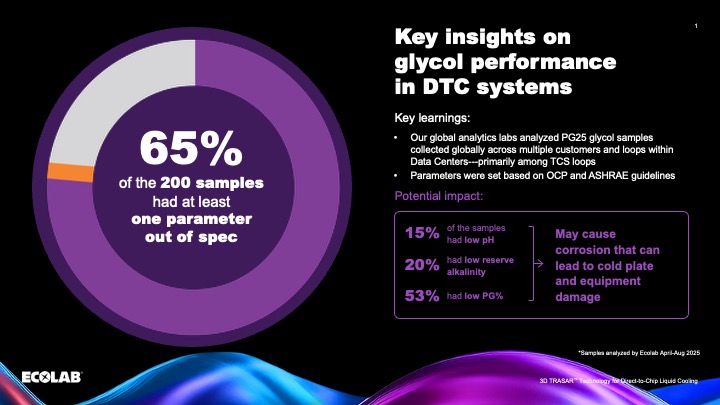
Operational variability increases risk. While the liquid coolants used in a DTC cooling system may be fit for their intended purpose, varying temperatures and flow rates, blade change-outs, touchpoints and other factors can contribute to potential fluid breakdown. In fact, our initial sampling of technical cooling systems globally found that nearly two-thirds of tested glycol coolant samples were out of specification, based on OCP and ASHRAE guidelines (Figure 1).
Ecolab addresses system variability through real-time fluid monitoring to gain insights into system performance. This differs from scheduled laboratory sampling, where leading and lagging indicators are the same. Continuous data and insights help identify and address cooling system issues proactively and optimise cooling performance against demand.
3D TRASAR Technology for Direct-to-Chip Liquid Cooling leverages robust, low-maintenance sensors to track pH, conductivity, glycol concentration, temperature and flow in real time, monitoring coolant health and supporting the efficient, effective cooling of high-performance computing (HPC) servers.
Ecolab is a global leader in fluid management and cooling technologies for data centres and high-performance computing. Visit our website to learn how we can help your organisation maximise cooling system performance and lifespan, from design to operation.
Cooling is a mission-critical system that directly impacts performance, uptime, and operational efficiency. Direct-to-chip liquid cooling is the solution. Read More Data Centre Review
In the AI era, one fact is unavoidable: cooling is no longer an afterthought in data centre design; it is a mission-critical system that directly impacts performance, uptime and operational efficiency. As rack power densities climb, heat loads are exceeding the limits of air-based cooling. Direct-to-chip (DTC) liquid cooling has emerged as a leading solution.
The benefits are clear: DTC cooling supports server performance and reliability by delivering coolant directly to heat-generating components, significantly enhancing heat removal. Directly cooling chips lowers overall energy consumption, improving operational efficiency. However, DTC cooling systems encounter four common challenges:
As a global leader in liquid cooling, Ecolab is pioneering new standards and best practices for DTC cooling system design, start-up and operation. To help operators build and commission optimised DTC systems, we follow three mantras: design clean, start clean and operate clean.
DTC system projects often start by collaborating with design engineers and industry experts before a site is even built. Ecolab considers factors such as climate, geography, power generation source, water scarcity, water quality and more when assessing potential sites.
Given water’s cooling advantages, costs and potential scarcity, we recommend a pragmatic approach: leveraging water only where it makes sense. Often, water-related challenges can be prevented through thoughtful design.
At the DTC system level, compatible metallurgies and fluid adjustment accessibility can also help mitigate corrosion and speed system optimisation. Operators must also consider how higher temperatures affect facility loops and how design and coolant choices influence performance, efficiency and system longevity.
Industry leaders and members of the American Society of Heating, Refrigerating and Air-Conditioning Engineers (ASHRAE) have developed standards and best practices for DTC data centre cooling systems based on firsthand experience. ASHRAE published an article, ‘Water-Cooled Servers: Common Designs, Components and Processes’, that outlines the current standards for data centre cooling system design and operation.
With many small passages within cooling systems, pre-commissioning pipework cleaning is an involved but essential process. Successful pipework cleaning and flushing of new systems ensure liquid-cooled racks are free of corrosion by-products, debris and leaks that could delay commissioning.
Ecolab and NVIDIA cooling system specialists have collaborated on comprehensive pre-commissioning specifications to guide new pipework cleaning and ensure optimal heat-transfer efficiency in liquid-cooled racks. The article, ‘Guidelines for Pre-Commission Preparation of Technology Cooling System (TCS) Row Manifolds in Liquid Cooled Data Centers’, was published by the Open Compute Project (OCP) in compliance with its five core tenets – openness, efficiency, impact, scale and sustainability – to create an innovative, sound methodology.
One of the biggest misconceptions regarding liquid-cooling fluid management is that DTC cooling systems are set-it-and-forget-it.
Operational variability increases risk. While the liquid coolants used in a DTC cooling system may be fit for their intended purpose, varying temperatures and flow rates, blade change-outs, touchpoints and other factors can contribute to potential fluid breakdown. In fact, our initial sampling of technical cooling systems globally found that nearly two-thirds of tested glycol coolant samples were out of specification, based on OCP and ASHRAE guidelines (Figure 1).
Ecolab addresses system variability through real-time fluid monitoring to gain insights into system performance. This differs from scheduled laboratory sampling, where leading and lagging indicators are the same. Continuous data and insights help identify and address cooling system issues proactively and optimise cooling performance against demand.
3D TRASAR™ Technology for Direct-to-Chip Liquid Cooling leverages robust, low-maintenance sensors to track pH, conductivity, glycol concentration, temperature and flow in real time, monitoring coolant health and supporting the efficient, effective cooling of high-performance computing (HPC) servers.
Ecolab is a global leader in fluid management and cooling technologies for data centres and high-performance computing. Visit our website to learn how we can help your organisation maximise cooling system performance and lifespan, from design to operation.