
# # #
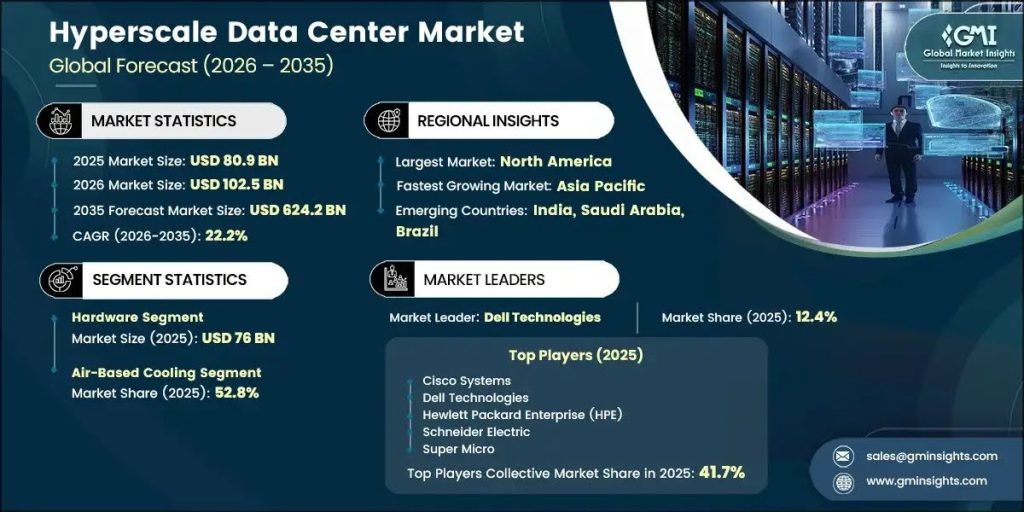
The global hyperscale data center market was valued at USD 80.9 billion in 2025 and is estimated to grow at a CAGR of 22.2% to reach USD 624.2 billion by 2035, according to the recent report by Global Market Insights Inc.
The market expansion is shaped by major changes in computing infrastructure, including the shift toward AI-focused architectures, high-performance computing environments, and increased dependence on cloud-based enterprise platforms. The growing need for advanced processing capacity for artificial intelligence applications is encouraging hyperscale operators to deploy GPU-intensive server environments with significantly higher rack power densities compared with traditional computing systems.
AI model development and large-scale data processing require advanced infrastructure capable of supporting high-performance workloads, creating substantial demand for hyperscale facilities. Enterprise digital transformation and the continued movement of business applications to public cloud platforms are further strengthening market growth. In addition, hyperscale companies are increasing investments in renewable energy procurement to support sustainability objectives and meet rising power requirements. The technology sector represented nearly 40% of corporate renewable power purchase agreements in 2025, highlighting the increasing role of hyperscale operators in clean energy adoption. Large-scale renewable energy agreements signed by major technology companies demonstrate a long-term approach toward securing reliable and sustainable energy sources for future data center expansion.
The hyperscale data center market from the hardware segment accounted for USD 76 billion, representing 93.9% share in 2025. This dominance is attributed to the significant capital requirements associated with hyperscale infrastructure development. Servers, storage systems, networking equipment, power management solutions, and cooling technologies collectively account for most of the investment required to establish and expand hyperscale facilities.
The air-based cooling systems segment held a 52.8% share, valued at USD 42.7 billion in 2025, owing to increasing thermal management requirements from AI-driven GPU infrastructure. Direct-to-chip (DTC) liquid cooling has emerged as the most adopted liquid cooling method, as it enables coolant circulation through cold plates attached directly to processors and memory components. This approach provides effective heat removal while allowing integration with existing data center designs without requiring complete infrastructure replacement.
North America hyperscale data center market held 42.8% share in 2025. The region continues to serve as the foundation of worldwide hyperscale investment, supported by significant infrastructure expansion from leading cloud and technology companies across major data center hubs. Continued capital spending by Amazon Web Services, Microsoft Azure, Google Cloud, Meta Platforms, and Oracle is contributing to the development of advanced hyperscale facilities across key markets, strengthening North America’s position in the global industry.
Key players operating in the global hyperscale data center market include Schneider Electric, Vertiv Group, Dell Technologies, Hewlett Packard Enterprise (HPE), Cisco Systems, Huawei Technologies, Super Micro Computer, Arista Networks, Lenovo, Eaton, Legrand, Hitachi, Gigabyte Technology, MiTAC Holdings, Cormant Technologies, Mortenson Construction, DPR Construction, Vast Data, LiquidStack, and GRC.
Companies operating in the hyperscale data center market are adopting strategies focused on infrastructure expansion, strategic partnerships, technological innovation, and sustainability initiatives to strengthen their market position. Industry participants are investing in advanced cooling solutions, high-density computing infrastructure, renewable energy integration, and next-generation networking technologies to address increasing AI and cloud workload requirements. Companies are also expanding their global data center footprints through new facility construction, acquisitions, and collaborations with energy providers and technology partners. Developing energy-efficient designs, improving operational reliability, and enhancing data center automation capabilities are key priorities for market participants.
The post Hyperscale Data Center Market to Surpass USD 624.2 Billion by 2035 appeared first on Data Center POST.
TL;DR The global hyperscale data center market is projected to skyrocket from USD 80.9 billion in 2025 to USD 624.2 billion by 2035, expanding at a compound annual growth rate (CAGR) of 22.2%. This explosive growth is heavily driven by AI-focused architectures, high-performance computing (HPC), and public cloud migrations, which require massive deployment of GPU-intensive
The post Hyperscale Data Center Market to Surpass USD 624.2 Billion by 2035 appeared first on Data Center POST. Read More Data Center POST
# # #
The global hyperscale data center market was valued at USD 80.9 billion in 2025 and is estimated to grow at a CAGR of 22.2% to reach USD 624.2 billion by 2035, according to the recent report by Global Market Insights Inc.
The market expansion is shaped by major changes in computing infrastructure, including the shift toward AI-focused architectures, high-performance computing environments, and increased dependence on cloud-based enterprise platforms. The growing need for advanced processing capacity for artificial intelligence applications is encouraging hyperscale operators to deploy GPU-intensive server environments with significantly higher rack power densities compared with traditional computing systems.
AI model development and large-scale data processing require advanced infrastructure capable of supporting high-performance workloads, creating substantial demand for hyperscale facilities. Enterprise digital transformation and the continued movement of business applications to public cloud platforms are further strengthening market growth. In addition, hyperscale companies are increasing investments in renewable energy procurement to support sustainability objectives and meet rising power requirements. The technology sector represented nearly 40% of corporate renewable power purchase agreements in 2025, highlighting the increasing role of hyperscale operators in clean energy adoption. Large-scale renewable energy agreements signed by major technology companies demonstrate a long-term approach toward securing reliable and sustainable energy sources for future data center expansion.
The hyperscale data center market from the hardware segment accounted for USD 76 billion, representing 93.9% share in 2025. This dominance is attributed to the significant capital requirements associated with hyperscale infrastructure development. Servers, storage systems, networking equipment, power management solutions, and cooling technologies collectively account for most of the investment required to establish and expand hyperscale facilities.
The air-based cooling systems segment held a 52.8% share, valued at USD 42.7 billion in 2025, owing to increasing thermal management requirements from AI-driven GPU infrastructure. Direct-to-chip (DTC) liquid cooling has emerged as the most adopted liquid cooling method, as it enables coolant circulation through cold plates attached directly to processors and memory components. This approach provides effective heat removal while allowing integration with existing data center designs without requiring complete infrastructure replacement.
North America hyperscale data center market held 42.8% share in 2025. The region continues to serve as the foundation of worldwide hyperscale investment, supported by significant infrastructure expansion from leading cloud and technology companies across major data center hubs. Continued capital spending by Amazon Web Services, Microsoft Azure, Google Cloud, Meta Platforms, and Oracle is contributing to the development of advanced hyperscale facilities across key markets, strengthening North America’s position in the global industry.
Key players operating in the global hyperscale data center market include Schneider Electric, Vertiv Group, Dell Technologies, Hewlett Packard Enterprise (HPE), Cisco Systems, Huawei Technologies, Super Micro Computer, Arista Networks, Lenovo, Eaton, Legrand, Hitachi, Gigabyte Technology, MiTAC Holdings, Cormant Technologies, Mortenson Construction, DPR Construction, Vast Data, LiquidStack, and GRC.
Companies operating in the hyperscale data center market are adopting strategies focused on infrastructure expansion, strategic partnerships, technological innovation, and sustainability initiatives to strengthen their market position. Industry participants are investing in advanced cooling solutions, high-density computing infrastructure, renewable energy integration, and next-generation networking technologies to address increasing AI and cloud workload requirements. Companies are also expanding their global data center footprints through new facility construction, acquisitions, and collaborations with energy providers and technology partners. Developing energy-efficient designs, improving operational reliability, and enhancing data center automation capabilities are key priorities for market participants.