
Open networking delivers strategic value, but DIY disaggregation adds risk and hidden cost. Cisco-validated SONiC on the N9000 combines open-source agility with proven Cisco reliability and global support. Open networking delivers strategic value, but DIY disaggregation adds risk and hidden cost. Cisco-validated SONiC on the N9000 combines open-source agility with proven Cisco reliability and global support. Read More Data Center - Cisco Blogs
Open networking delivers strategic value, but DIY disaggregation can add operational risk, siloed support, and hidden cost; Cisco-validated SONiC on Cisco N9000 Series Switches combines open-source agility across AI and non-AI clusters with proven Cisco reliability and support.
Open networking was never designed to be an architectural belief. It was meant to be a business and operational strategy. For web-scale operators and neocloud providers, decoupling the network operating system (NOS) from hardware created a compelling path to lower CapEx, eliminate vendor lock-in, and control the network stack. However, as open-source networking expands into broader enterprise and high-density AI environments, many organizations are discovering the downside of a pure “do-it-yourself” model.
The challenge isn’t the value of openness; it’s the disaggregation tax. In practice, DIY disaggregation models often introduce massive operational overhead, fragmented support boundaries, and unpredictable debugging cycles that consume highly specialized engineering resources. That is a costly tradeoff when performance, scale, and uptime matter the most.
We believe open networking should improve unit economics, support operational longevity, and maximize workload efficiency—without forcing teams to choose between rigid proprietary stacks and high-risk DIY open source. By delivering Cisco-validated SONiC across the Cisco N9000 Series, we pair open-source NOS agility with trusted Cisco reliability, intelligent buffer management, ecosystem, and end-to-end global support.
Building a custom NOS on commodity white-box hardware sounds compelling at first. The picture changes when engineering and operations teams absorb the burden of keeping that environment stable from pilot to production and accumulate operational costs. Three issues stand out:
We take a fundamentally different approach. Cisco is not simply enabling open-source binary on Cisco N9000 Series Switches; we’re actively engineering the foundation behind it.
Cisco is the primary maintainer of Free Range Routing (FRR), the routing brain powering SONiC’s control plane. Cisco also sits on the SONiC Technical Steering Committee, drives SAI standards, and optimizes open-source stacks directly across both Cisco ASICs (Silicon One and Cloud Scale) and market-leading technology partner ASICs (such as NVIDIA Spectrum-X Ethernet switch silicon). This multi-silicon approach gives architectural flexibility across traditional and extreme-density AI environments without forcing a complete hardware reset.
Standardizing on the Cisco N9000 Series gives organizations investment protection, simplifying lifecycle management while preserving operational flexibility. Because the underlying Cisco Nexus (N9000) switches and Cisco Optics remain constant, the exact same switch can run Cisco NX-OS, Cisco ACI, or Cisco-validated SONiC. If your operational model or business strategy shifts, your hardware infrastructure remains a long-term asset.
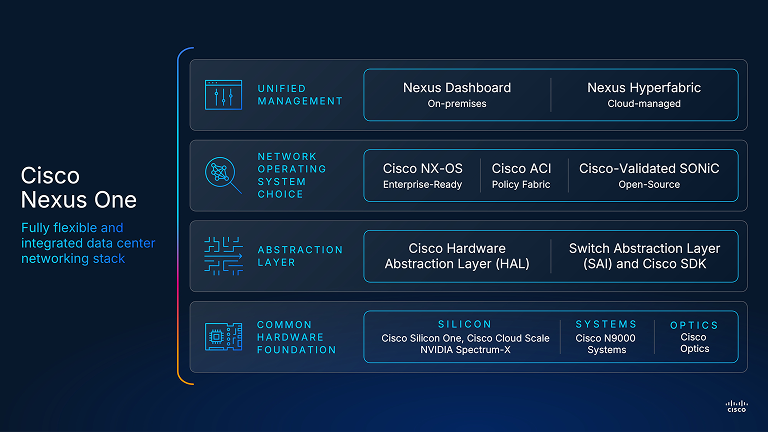
SONiC is purpose-built for scale-out operating models—Linux-native, automation-first, and optimized for teams that manage infrastructure as code. It delivers that value best when adopted on its own terms, rather than evaluated as a feature-for-feature substitute for Cisco NX-OS or Cisco ACI. Matching it against every legacy enterprise feature and workflow misapplies the model and can lead to architectural misalignment.
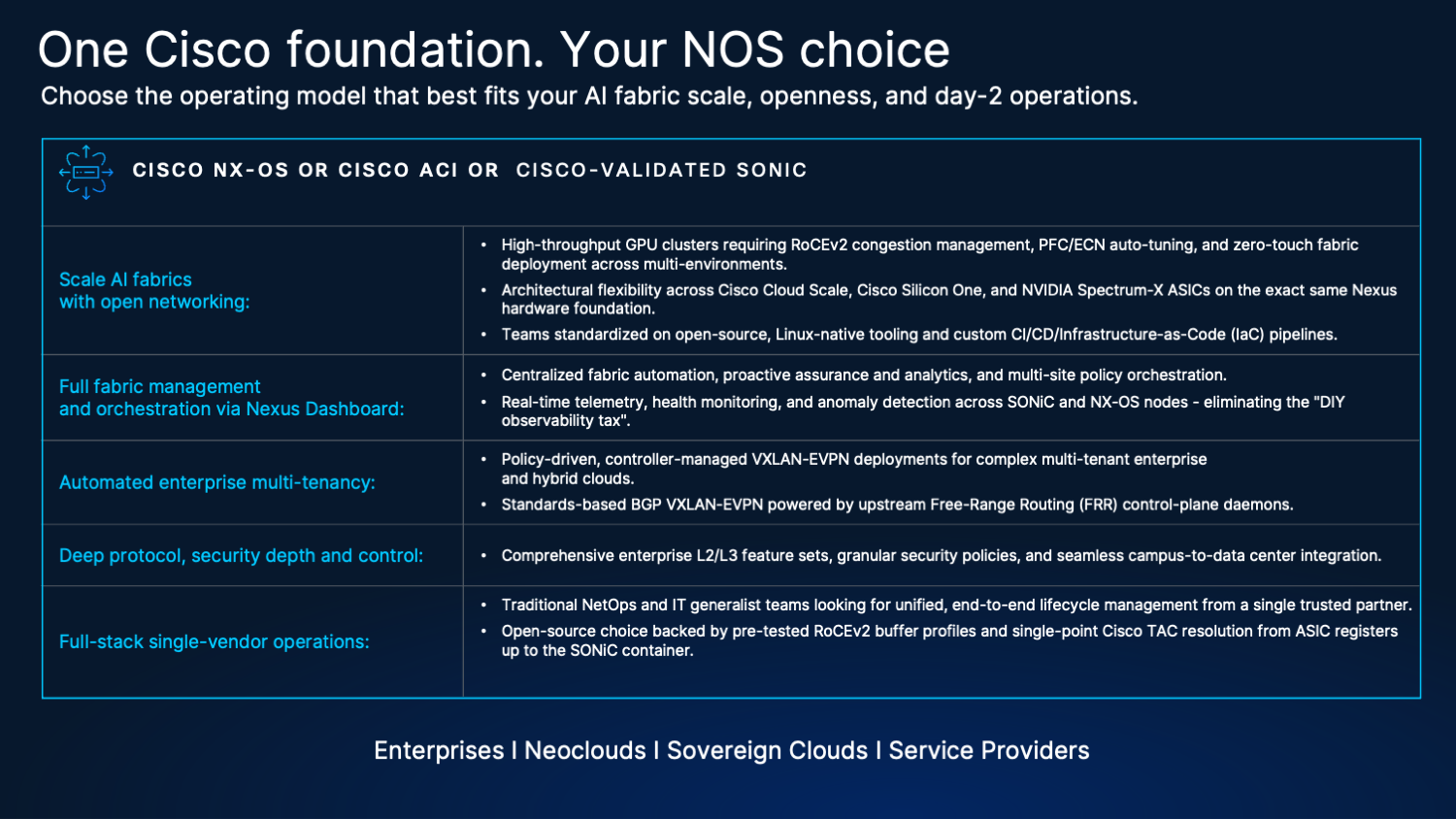
Success isn’t about choosing a superior model; it’s about matching the right operational framework to your long-term strategy and business goals. The ideal approach hinges on your day-to-day operational priorities, in-house expertise, and workload profile.
One of the biggest barriers in open networking is fragmented support accountability. Cisco-validated SONiC on the Cisco N9000 Series addresses that directly.
Open networking reaches its full potential when disaggregation meets end-to-end architectural consistency. For organizations deploying Cisco 8000 Series across WAN backbones and core transport, extending Cisco-validated SONiC to the Nexus switches creates a unified, end-to-end open network fabric. Customers eliminate vendor silos, leveraging a single supply chain, shared FRR routing tools, and one TAC contract from the WAN edge deep into the data center core.
While web-scale and hyperscale engineering teams leverage community SONiC on the Cisco 8000 Series for full DIY disaggregation, enterprise and neocloud teams often need open networking economics without the compiler overhead. To meet customers how and where they operate, Cisco supports both models: pure disaggregation on Cisco 8000 for DIY shops, and Cisco-validated SONiC on Cisco N9000 Series Switches for preconfigured, TAC-supported deployments.
This flexibility allows organizations to adopt open networking on their own terms, without sacrificing hardware consistency or support. The future of data center networking isn’t about choosing between open-source or proprietary NOS. Cisco meets customers wherever they are in their transformation journeys—preserving operational choice without forcing tradeoffs.
With Cisco, organizations can choose the maturity of Cisco NX-OS, the fabric automation of Cisco ACI, and Cisco-validated, enterprise-grade SONiC with Cisco Nexus switches, or the open-source agility of SONiC on the Cisco 8000 Series, all on the same industry-leading hardware foundation and the same unwavering commitment to your success. That combination of NOS choice, deep telemetry, silicon diversity, and global support infrastructure helps your networks scale securely into the AI era.
Cisco is taking a complete approach to scale-across, from systems, software, and optics. SONiC contributions, FRR work, Silicon One integration, MACsec, telemetry, EVPN/VXLAN, SRv6, and deployment models play a key role in offering a complete solution for all customers. Customers can then approach their offering from a build-your-own approach to a fully validated Cisco-supported design. The scale-across market is rapidly developing into one of the fastest areas of growth in AI networking and poised to exceed $50B by the end of the decade.Alan Weckel, Technology Analyst, 650 Group
Join Cisco at the 2026 OCP Global Summit in San Jose, California, October 12 to 15, 2026, to see the next generation of AI-ready data center innovations in action.
Let’s build an open networking future together.

Additional resources: