
# # #
Data centers are a ginormous investment, but the environmental impact is higher. It relies not only on the operation, but also on the colossal construction that we see.
A typical data center invests in construction, raw materials, labour, land, electricity, water. But still basic building components
What separates it from a regular construction is the tech hardware. GPUs, running to thousands of dollars in a single square foot of space. Network connection, time, energy, memory, rack, vSAN, rack firmware and many more.
And only after building the entire building of the data center that we can actually operate it.
It is the usage of this labour force. And it’s the colossal structures. Based on county permitting records and facility reporting, xAI’s Colossus cluster spans roughly 207 acres and about 2.6 million square feet of building across its three sites in Memphis and Southaven, holding around 770,000 GPUs and delivering about 1 GW of compute as of March 2026. That is roughly 45 football fields of building. That is what you’re thinking of when you compare the DC.
In all of this we forget the time and cost of engineers and skilled labour transported from all parts of the world. Maintenance and construction workers for the building, access points and portals, generators, electrical engineers, mechanical engineers, plumbers, civil engineers, the big architecture firm employed to complete the work, and the construction companies building each one of the units in the most cost-effective method.
Once the DC is set up you have the network operators, the servers, the actual IT teams, and many more employed for the maintenance and career-long employment that this development would otherwise not have created.
There are benefits of data centers, in society as a whole. The introduction of employment opportunities and the economic value unlocked for society as a whole.
By the Data Center Coalition’s own accounting, the US data center industry directly employed more than 1 million workers in 2024 and supported 5.5 million jobs in total, with a tax contribution of $204 billion to local, state and federal government. The American Edge Project projects a further 4.7 million temporary construction jobs, against buildout spending McKinsey estimates at up to $7 trillion by 2030. Those are industry figures and should be read as such, but the construction side of them matches what I have seen on site.
Energy utilization in operation has never been the whole burden. Getting power to the site is. Data centers used about 4.4% of total US electricity in 2023, and the Lawrence Berkeley National Laboratory projects 6.7% to 12% by 2028, which is exactly why interconnection, not code, is the thing that stops a build.
Only after which the operation itself is a conversation point. Only after the completion of development itself could it be reduced to an understanding of climate impact. The DC does not by itself operate in a closed or open loop system.
It’s a choice. In a closed loop system the water circulates in a sealed circuit and is reused, so almost none of it is consumed. It is the same technology as the air conditioning you’re sitting in, the same systems used in offices, malls and your car. An open loop or evaporative system is the one that consumes water, because the water is evaporated to reject heat and has to be continuously replaced. So if your standalone office building on a sealed loop doesn’t drain the local water supply, a data center on the same design won’t either. The ones that do are the evaporative builds, and that is a design decision, not an inevitability.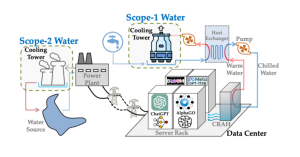
You also have to see the impact of DCs not on an individual level but from the humanitarian impact of DCs as a whole. Industry trackers count roughly 2,100 operational data centers in the US, or as many as 4,400 depending on whether enterprise sites are included, with another 800 under construction, catering to hundreds of millions of users globally, including all AI and non-AI users. A simple Google search today is also powered by AI, and Google says it engages over a billion people in AI-assisted interactions each day. Can any person interacting with digital tech go without seeing the effects of AI in their day-to-day lives?
It’s like comparing a group activity to the individual impact. And creating a massive misalignment in the expectation of how much power will be used, measured against a sub-Saharan comparison. Let me tell you, it is also high power to use your phone and device to read this article, given that the same water could be provided to people in sub-Saharan Africa.
The US Geological Survey puts the water consumption of a quarter-pound beef patty at about 460 gallons, and a full cheeseburger at around 660. Against the minimum annual domestic water need used in the UN University’s own reporting, roughly 7,400 litres per person, four beef patties is one person’s entire year of water in sub-Saharan Africa. Every industry looks monstrous under this metric. So if saving water and environmental impact is the goal of your life, starting by quitting your cheeseburgers is a good strategy.
The comparison, by far, makes an individual-to-individual consumption and impact. You would at least therefore actually be able to contribute and balance the compensation of using AI, by quitting a cheeseburger once a month.
So next time you think a DC is bad for the environment, it will be the same as questioning the field of agriculture, transportation, steel, or anything consumer.
Everything above is an argument about context. It is not a defence you get to use. If you are financing, siting, or operating a build, it is a set of conditions you have to actually meet. Six things I would put in front of a board.
The industry’s problem is not that the criticism is unfair. It is that we have handed people almost nothing to check it against. Every operator that publishes a real number makes the next build easier to approve, including yours.
The headlines focus on multibillion-dollar investments and chip shortages, but the immediate bottleneck is not code. It is concrete, high-voltage power, specialized global supply chains, and the workforce needed to scale data centers. Even YC’s call for startup addresses this business prospect.
I have been the lead project manager on data-center builds for companies including Tesla, Cisco, and major data companies. I started by managing physical builds in India and later brought that infrastructure experience into the U.S. startup ecosystem. The article aims to give a real perspective on Datacenter investment.
# # #
Karishma is an expert in AI infrastructure and system design. She writes about the newest AI technology and about the changing landscape of tech affecting every other field.
Founder of Aidni, her company focuses on power analytics for data centers. She has previously held AI positions at Salesforce and Cisco
The post The Math and Engineering Behind Data Centers appeared first on Data Center POST.
TL;DR Securing power grid connections is the primary bottleneck halting new facilities, with U.S. data center electricity usage projected to increase from 4.4% in 2023 to between 6.7% and 12% by 2028. Rather than permanent site headcount, the core economic impact stems from heavy construction spending and tax revenues, supporting 5.5 million total U.S. jobs
The post The Math and Engineering Behind Data Centers appeared first on Data Center POST. Read More Data Center POST
# # #
Data centers are a ginormous investment, but the environmental impact is higher. It relies not only on the operation, but also on the colossal construction that we see.
A typical data center invests in construction, raw materials, labour, land, electricity, water. But still basic building components
What separates it from a regular construction is the tech hardware. GPUs, running to thousands of dollars in a single square foot of space. Network connection, time, energy, memory, rack, vSAN, rack firmware and many more.
And only after building the entire building of the data center that we can actually operate it.
It is the usage of this labour force. And it’s the colossal structures. Based on county permitting records and facility reporting, xAI’s Colossus cluster spans roughly 207 acres and about 2.6 million square feet of building across its three sites in Memphis and Southaven, holding around 770,000 GPUs and delivering about 1 GW of compute as of March 2026. That is roughly 45 football fields of building. That is what you’re thinking of when you compare the DC.
In all of this we forget the time and cost of engineers and skilled labour transported from all parts of the world. Maintenance and construction workers for the building, access points and portals, generators, electrical engineers, mechanical engineers, plumbers, civil engineers, the big architecture firm employed to complete the work, and the construction companies building each one of the units in the most cost-effective method.
Once the DC is set up you have the network operators, the servers, the actual IT teams, and many more employed for the maintenance and career-long employment that this development would otherwise not have created.
There are benefits of data centers, in society as a whole. The introduction of employment opportunities and the economic value unlocked for society as a whole.
By the Data Center Coalition’s own accounting, the US data center industry directly employed more than 1 million workers in 2024 and supported 5.5 million jobs in total, with a tax contribution of $204 billion to local, state and federal government. The American Edge Project projects a further 4.7 million temporary construction jobs, against buildout spending McKinsey estimates at up to $7 trillion by 2030. Those are industry figures and should be read as such, but the construction side of them matches what I have seen on site.
Energy utilization in operation has never been the whole burden. Getting power to the site is. Data centers used about 4.4% of total US electricity in 2023, and the Lawrence Berkeley National Laboratory projects 6.7% to 12% by 2028, which is exactly why interconnection, not code, is the thing that stops a build.
Only after which the operation itself is a conversation point. Only after the completion of development itself could it be reduced to an understanding of climate impact. The DC does not by itself operate in a closed or open loop system.
It’s a choice. In a closed loop system the water circulates in a sealed circuit and is reused, so almost none of it is consumed. It is the same technology as the air conditioning you’re sitting in, the same systems used in offices, malls and your car. An open loop or evaporative system is the one that consumes water, because the water is evaporated to reject heat and has to be continuously replaced. So if your standalone office building on a sealed loop doesn’t drain the local water supply, a data center on the same design won’t either. The ones that do are the evaporative builds, and that is a design decision, not an inevitability.
You also have to see the impact of DCs not on an individual level but from the humanitarian impact of DCs as a whole. Industry trackers count roughly 2,100 operational data centers in the US, or as many as 4,400 depending on whether enterprise sites are included, with another 800 under construction, catering to hundreds of millions of users globally, including all AI and non-AI users. A simple Google search today is also powered by AI, and Google says it engages over a billion people in AI-assisted interactions each day. Can any person interacting with digital tech go without seeing the effects of AI in their day-to-day lives?
It’s like comparing a group activity to the individual impact. And creating a massive misalignment in the expectation of how much power will be used, measured against a sub-Saharan comparison. Let me tell you, it is also high power to use your phone and device to read this article, given that the same water could be provided to people in sub-Saharan Africa.
The US Geological Survey puts the water consumption of a quarter-pound beef patty at about 460 gallons, and a full cheeseburger at around 660. Against the minimum annual domestic water need used in the UN University’s own reporting, roughly 7,400 litres per person, four beef patties is one person’s entire year of water in sub-Saharan Africa. Every industry looks monstrous under this metric. So if saving water and environmental impact is the goal of your life, starting by quitting your cheeseburgers is a good strategy.
The comparison, by far, makes an individual-to-individual consumption and impact. You would at least therefore actually be able to contribute and balance the compensation of using AI, by quitting a cheeseburger once a month.
So next time you think a DC is bad for the environment, it will be the same as questioning the field of agriculture, transportation, steel, or anything consumer.
Everything above is an argument about context. It is not a defence you get to use. If you are financing, siting, or operating a build, it is a set of conditions you have to actually meet. Six things I would put in front of a board.
The industry’s problem is not that the criticism is unfair. It is that we have handed people almost nothing to check it against. Every operator that publishes a real number makes the next build easier to approve, including yours.
The headlines focus on multibillion-dollar investments and chip shortages, but the immediate bottleneck is not code. It is concrete, high-voltage power, specialized global supply chains, and the workforce needed to scale data centers. Even YC’s call for startup addresses this business prospect.
I have been the lead project manager on data-center builds for companies including Tesla, Cisco, and major data companies. I started by managing physical builds in India and later brought that infrastructure experience into the U.S. startup ecosystem. The article aims to give a real perspective on Datacenter investment.
# # #
Karishma is an expert in AI infrastructure and system design. She writes about the newest AI technology and about the changing landscape of tech affecting every other field.
Founder of Aidni, her company focuses on power analytics for data centers. She has previously held AI positions at Salesforce and Cisco