
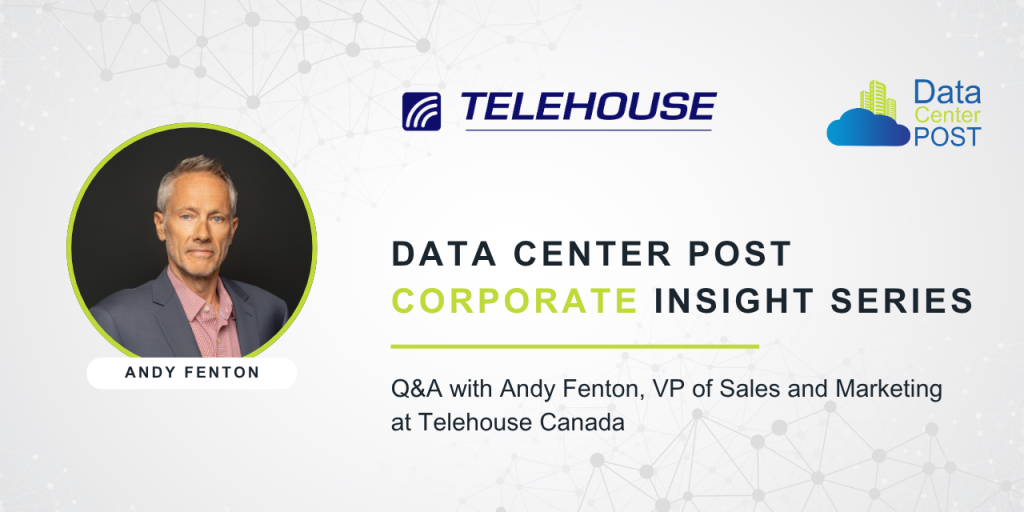
Data Center Post had the opportunity to connect with Andy Fenton, an accomplished telecom and data centre executive with over 20 years of experience in the industry. Currently serving as the VP of Sales and Marketing for Telehouse Canada, Andy oversees the company’s sales strategy to drive long-term growth and manages relationships with major telecom and big tech clients. Beginning his career at PSINet, he managed sales, business development, and the national sales team, where he gained valuable expertise in the colocation business. He then transitioned to Bell Canada as the General Manager for Bell’s Systems Integrator Group, managing relationships with key partners, including Accenture, Wipro and IBM Canada.
Prior to joining Telehouse, Andy spent 14 years at Cogeco as head of the Carrier and Strategic Accounts Team playing a crucial role in the company’s growth from a single location to over 15 data centres across Canada, the U.S. and the U.K. Over his career Andy developed and managed relationships with major telecom and technology companies including IBM, Accenture, Microsoft, Rogers, Telus, Hydro One and Tencent.
As a subsidiary of KDDI Corporation, a global leader in telecommunications, Telehouse brings 35 years of global expertise in providing reliable, secure, and flexible colocation services. Our family of data centres are all strategically placed in more than 40 locations around the world. From Paris to Shanghai, we maintain optimum SLA uptime standards of 99.999%.
In Canada, Telehouse operates three interconnected data centres in downtown Toronto, forming one of the country’s most established connectivity hubs. Telehouse Canada’s facilities provide direct access to a dense ecosystem of carriers, cloud providers, ASPs, and ISPs, enabling fast, low‑latency connectivity to key North American markets. Telehouse Canada supports organizations across diverse industries with secure, resilient, and highly interconnected infrastructure that drives growth and enables global reach.
We offer both shared and dedicated colocation space in all our data centres. Each data centre is connected through our dark fibre network, providing rapid access to a range of 200 + connectivity providers, including leading cloud service providers.
Our data centres act as the nerve centre of Canadian telecommunications, serving as a meeting point for internet service providers (ISP), application service providers (ASP) and Canada’s largest carrier networks to connect and exchange data.
Telehouse also supports high-density AI workloads while enabling edge deployment closer to end users through robust connectivity and interconnection.
Telehouse Canada helps organizations address critical infrastructure challenges, including the need for diverse, reliable low- latency connectivity, scalable capacity, and secure, high‑performance environments to support digital growth and AI workloads.
As part of a global platform of data centres, Telehouse enables direct access to leading cloud platforms, helping businesses to seamlessly connect to the services they need to optimize their infrastructure, support hybrid and multi-cloud strategies, and expand internationally.
Our carrier‑neutral colocation and interconnection solutions provide the flexibility to scale infrastructure on demand, optimize network performance, and improve business continuity. By tailoring solutions to each customer’s technical and business requirements, Telehouse Canada enables organizations to accelerate digital transformation, improve resilience, and compete effectively in the global digital economy.
This is particularly important as organizations deploy increasingly data-intensive applications, including AI workloads, which require greater infrastructure density, scalable capacity, and reliable connectivity.
Telehouse Canada provides a comprehensive portfolio of colocation, interconnection, and connectivity services from Canada’s most connected carrier-neutral data centre campus in downtown Toronto. Our colocation services range from single cabinets in shared environments to customized cages and dedicated suites, supporting everything from enterprise IT to high-density AI workloads.
We deliver seamless interconnection services through seven on-site Meet-Me Rooms, enabling customers to connect directly to a wide ecosystem. Our fully managed, network-neutral environment simplifies network expansion and accelerates deployment, while diverse pathways and secure infrastructure ensure resilience, redundancy, and route diversity.
Connectivity services provide low-latency, flexible solutions designed to support cloud on-ramps, hybrid and multi-cloud architectures, and high-performance data exchange. These services together enable businesses to support latency-sensitive applications and scale efficiently within a highly interconnected digital ecosystem.
We serve a variety of markets, including enterprises and small to medium businesses, cloud services providers, tech startups and scale-ups, financial institutions, healthcare organizations, AI developers, e-commerce platforms, content providers, government agencies, and educational institutions.
As AI adoption accelerates, the demands placed on digital infrastructure are rapidly evolving. Organizations are seeking data centre environments capable of supporting performance-intensive workloads at scale, driving the need for higher-density architectures and more advanced, efficient cooling solutions.
At the same time, the focus is shifting toward infrastructure that can balance performance with resilience and sustainability. Businesses increasingly require low-latency, energy-efficient environments that can handle growing volumes of data exchange while supporting broader environmental and operational goals.
These challenges are further compounded by constraints around power availability and energy capacity, which are reshaping how infrastructure is designed, deployed, and scaled. In parallel, the importance of sovereign infrastructure continues to grow, as organizations look to ensure data residency, meet regulatory requirements, and maintain greater control over critical digital assets.
Telehouse Canada is actively advancing its infrastructure to meet the growing demands of AI, high‑density deployments, and increased connectivity requirements. We are investing in infrastructure designed to support performance-intensive AI workloads, incorporating advanced technologies such as direct‑to‑chip liquid cooling to efficiently support performance‑intensive workloads. Liquid cooling is more thermally conductive than air, allowing Telehouse Canada to remove up to 80 per cent of heat directly from high-power server components. As a result, reliance on power-intensive computer room air conditioners and server fans is reduced, lowering overall energy consumption while delivering a more sustainable and efficient cooling model. Combined with our dense interconnection ecosystem and carrier-neutral environment, these upgrades help customers scale AI workloads while maintaining fast, reliable access to networks, cloud providers and end users.
To address rising power and efficiency challenges, Telehouse Canada focuses on optimizing energy use through innovative cooling approaches and a high‑efficiency facility design. Our Toronto data centres leverage renewable energy sources and integrate sustainable cooling solutions, including Enwave’s Deep Lake Water Cooling system, reducing environmental impact while supporting continued capacity growth.
Additionally, in response to growing demand for sovereign infrastructure, Telehouse Canada offers secure, Canadian‑based data centre solutions that support local data residency, regulatory compliance, and greater control over critical digital assets. This is particularly important for organizations in regulated industries and those prioritizing national data sovereignty.
Through a combination of advanced cooling technologies, energy‑efficient design, rich interconnection, and locally operated infrastructure, Telehouse Canada enables organizations to scale AI workloads, improve performance, and build resilient, future‑ready digital platforms.
More than half (50 per cent) of all Canada’s carriers, service providers (xSPs) and content providers have a presence at Telehouse Canada’s data centres, making this interconnected hub the main gateway for Canada’s internet traffic flow, helping Canadians connect digitally with each other and the rest of the world. By connecting different networks and providers together, our data centres play an important role in facilitating Canadians’ experience of the digital world as vast, seamless, fast, and interconnected.
For Canadian consumers, data centres act as conduits for the flow of all our important data. Whether it’s the content we stream on our devices or the emails we send to colleagues, most of that content likely passes through our data centres as it moves between networks.
For businesses and public sector organizations, 151 Front Street West and its sister data centres are the primary gateway through which all commerce, content and communications data is shared both domestically and globally.
As part of a global platform of data centres, Telehouse enables customers to seamlessly extend their infrastructure internationally, supporting global expansion with consistent interconnection and colocation services.
Canada is known around the world for its technology leadership, including advanced research, top-tier talent and the growth of innovative companies. We’re focused on expanding the capacity of our facilities and advancing their capabilities to meet the growing demand for connectivity services.
We also remain focused on enhancing customer experience and delivering greater value— staying ahead by fostering partnerships, innovating our own operations, and aligning with global best practices.
We will be attending RAISE Paris 2026 (July 8-9), ALL IN 2026 (Sept. 16-17), and AI Infra Summit (Sept. 15-17).
Telehouse Canada has completed a major infrastructure upgrade featuring a first-of-its-kind deployment of direct liquid cooling within an interconnection hub in Canada, enabling high-density AI workloads and cabinet densities of up to 120 kW per rack within its downtown Toronto data centre campus.
The investment strengthens Telehouse Canada’s ability to support AI-driven operations by combining advanced cooling technology with resilient, low-latency, interconnection-rich infrastructure designed for performance-intensive workloads at scale.
The upgrade also advances sustainability efforts by reducing overall energy consumption and repurposing captured heat through Enwave’s district energy system, while supporting Canada’s broader digital infrastructure and AI innovation goals.
Readers can learn more about the upgrade here.
Given our established connectivity hubs and our major infrastructure upgrade, Telehouse Canada continues to prioritize a strong commitment to supporting Canadian businesses and the economy.
As content distribution and edge computing continue to evolve, neocloud providers and AI companies are increasingly looking for power and capacity closer to carrier hotels and major connectivity hubs. While early AI factories were often built in remote locations focused on training workloads, there is now a growing trend toward inference workloads being deployed closer to end users and closer to the edge.
At the same time, rack density requirements are increasing significantly, with demand moving from roughly 40kW to 120kW per rack. While many new AI-focused data centres are being built, they still require fibre connectivity and interconnection back to carrier hotels like Telehouse Canada. The industry expected this shift toward highly interconnected AI infrastructure to happen eventually, but it appears to be occurring sooner than anticipated. As a result, facilities located adjacent to carrier hotels and internet exchanges are becoming increasingly important, and Telehouse is well positioned to support this evolution by providing both high-density infrastructure and the connectivity required to bring these environments together.
Readers can visit telehouse.ca to learn more about our company and follow us on our social platforms, like LinkedIn, X, Facebook, and YouTube, to stay up to date on announcements and events we’re attending.
Readers can contact us via our website online, linked here.
The post Corporate Profile: A Conversation with Andy Fenton, VP of Sales and Marketing at Telehouse Canada appeared first on Data Center POST.
Data Center Post had the opportunity to connect with Andy Fenton, an accomplished telecom and data centre executive with over 20 years of experience in the industry. Currently serving as the VP of Sales and Marketing for Telehouse Canada, Andy oversees the company’s sales strategy to drive long-term growth and manages relationships with major telecom
The post Corporate Profile: A Conversation with Andy Fenton, VP of Sales and Marketing at Telehouse Canada appeared first on Data Center POST. Read More Data Center POST
Data Center Post had the opportunity to connect with Andy Fenton, an accomplished telecom and data centre executive with over 20 years of experience in the industry. Currently serving as the VP of Sales and Marketing for Telehouse Canada, Andy oversees the company’s sales strategy to drive long-term growth and manages relationships with major telecom and big tech clients. Beginning his career at PSINet, he managed sales, business development, and the national sales team, where he gained valuable expertise in the colocation business. He then transitioned to Bell Canada as the General Manager for Bell’s Systems Integrator Group, managing relationships with key partners, including Accenture, Wipro and IBM Canada.
Prior to joining Telehouse, Andy spent 14 years at Cogeco as head of the Carrier and Strategic Accounts Team playing a crucial role in the company’s growth from a single location to over 15 data centres across Canada, the U.S. and the U.K. Over his career Andy developed and managed relationships with major telecom and technology companies including IBM, Accenture, Microsoft, Rogers, Telus, Hydro One and Tencent.
As a subsidiary of KDDI Corporation, a global leader in telecommunications, Telehouse brings 35 years of global expertise in providing reliable, secure, and flexible colocation services. Our family of data centres are all strategically placed in more than 40 locations around the world. From Paris to Shanghai, we maintain optimum SLA uptime standards of 99.999%.
In Canada, Telehouse operates three interconnected data centres in downtown Toronto, forming one of the country’s most established connectivity hubs. Telehouse Canada’s facilities provide direct access to a dense ecosystem of carriers, cloud providers, ASPs, and ISPs, enabling fast, low‑latency connectivity to key North American markets. Telehouse Canada supports organizations across diverse industries with secure, resilient, and highly interconnected infrastructure that drives growth and enables global reach.
We offer both shared and dedicated colocation space in all our data centres. Each data centre is connected through our dark fibre network, providing rapid access to a range of 200 + connectivity providers, including leading cloud service providers.
Our data centres act as the nerve centre of Canadian telecommunications, serving as a meeting point for internet service providers (ISP), application service providers (ASP) and Canada’s largest carrier networks to connect and exchange data.
Telehouse also supports high-density AI workloads while enabling edge deployment closer to end users through robust connectivity and interconnection.
Telehouse Canada helps organizations address critical infrastructure challenges, including the need for diverse, reliable low- latency connectivity, scalable capacity, and secure, high‑performance environments to support digital growth and AI workloads.
As part of a global platform of data centres, Telehouse enables direct access to leading cloud platforms, helping businesses to seamlessly connect to the services they need to optimize their infrastructure, support hybrid and multi-cloud strategies, and expand internationally.
Our carrier‑neutral colocation and interconnection solutions provide the flexibility to scale infrastructure on demand, optimize network performance, and improve business continuity. By tailoring solutions to each customer’s technical and business requirements, Telehouse Canada enables organizations to accelerate digital transformation, improve resilience, and compete effectively in the global digital economy.
This is particularly important as organizations deploy increasingly data-intensive applications, including AI workloads, which require greater infrastructure density, scalable capacity, and reliable connectivity.
Telehouse Canada provides a comprehensive portfolio of colocation, interconnection, and connectivity services from Canada’s most connected carrier-neutral data centre campus in downtown Toronto. Our colocation services range from single cabinets in shared environments to customized cages and dedicated suites, supporting everything from enterprise IT to high-density AI workloads.
We deliver seamless interconnection services through seven on-site Meet-Me Rooms, enabling customers to connect directly to a wide ecosystem. Our fully managed, network-neutral environment simplifies network expansion and accelerates deployment, while diverse pathways and secure infrastructure ensure resilience, redundancy, and route diversity.
Connectivity services provide low-latency, flexible solutions designed to support cloud on-ramps, hybrid and multi-cloud architectures, and high-performance data exchange. These services together enable businesses to support latency-sensitive applications and scale efficiently within a highly interconnected digital ecosystem.
We serve a variety of markets, including enterprises and small to medium businesses, cloud services providers, tech startups and scale-ups, financial institutions, healthcare organizations, AI developers, e-commerce platforms, content providers, government agencies, and educational institutions.
As AI adoption accelerates, the demands placed on digital infrastructure are rapidly evolving. Organizations are seeking data centre environments capable of supporting performance-intensive workloads at scale, driving the need for higher-density architectures and more advanced, efficient cooling solutions.
At the same time, the focus is shifting toward infrastructure that can balance performance with resilience and sustainability. Businesses increasingly require low-latency, energy-efficient environments that can handle growing volumes of data exchange while supporting broader environmental and operational goals.
These challenges are further compounded by constraints around power availability and energy capacity, which are reshaping how infrastructure is designed, deployed, and scaled. In parallel, the importance of sovereign infrastructure continues to grow, as organizations look to ensure data residency, meet regulatory requirements, and maintain greater control over critical digital assets.
Telehouse Canada is actively advancing its infrastructure to meet the growing demands of AI, high‑density deployments, and increased connectivity requirements. We are investing in infrastructure designed to support performance-intensive AI workloads, incorporating advanced technologies such as direct‑to‑chip liquid cooling to efficiently support performance‑intensive workloads. Liquid cooling is more thermally conductive than air, allowing Telehouse Canada to remove up to 80 per cent of heat directly from high-power server components. As a result, reliance on power-intensive computer room air conditioners and server fans is reduced, lowering overall energy consumption while delivering a more sustainable and efficient cooling model. Combined with our dense interconnection ecosystem and carrier-neutral environment, these upgrades help customers scale AI workloads while maintaining fast, reliable access to networks, cloud providers and end users.
To address rising power and efficiency challenges, Telehouse Canada focuses on optimizing energy use through innovative cooling approaches and a high‑efficiency facility design. Our Toronto data centres leverage renewable energy sources and integrate sustainable cooling solutions, including Enwave’s Deep Lake Water Cooling system, reducing environmental impact while supporting continued capacity growth.
Additionally, in response to growing demand for sovereign infrastructure, Telehouse Canada offers secure, Canadian‑based data centre solutions that support local data residency, regulatory compliance, and greater control over critical digital assets. This is particularly important for organizations in regulated industries and those prioritizing national data sovereignty.
Through a combination of advanced cooling technologies, energy‑efficient design, rich interconnection, and locally operated infrastructure, Telehouse Canada enables organizations to scale AI workloads, improve performance, and build resilient, future‑ready digital platforms.
More than half (50 per cent) of all Canada’s carriers, service providers (xSPs) and content providers have a presence at Telehouse Canada’s data centres, making this interconnected hub the main gateway for Canada’s internet traffic flow, helping Canadians connect digitally with each other and the rest of the world. By connecting different networks and providers together, our data centres play an important role in facilitating Canadians’ experience of the digital world as vast, seamless, fast, and interconnected.
For Canadian consumers, data centres act as conduits for the flow of all our important data. Whether it’s the content we stream on our devices or the emails we send to colleagues, most of that content likely passes through our data centres as it moves between networks.
For businesses and public sector organizations, 151 Front Street West and its sister data centres are the primary gateway through which all commerce, content and communications data is shared both domestically and globally.
As part of a global platform of data centres, Telehouse enables customers to seamlessly extend their infrastructure internationally, supporting global expansion with consistent interconnection and colocation services.
Canada is known around the world for its technology leadership, including advanced research, top-tier talent and the growth of innovative companies. We’re focused on expanding the capacity of our facilities and advancing their capabilities to meet the growing demand for connectivity services.
We also remain focused on enhancing customer experience and delivering greater value— staying ahead by fostering partnerships, innovating our own operations, and aligning with global best practices.
We will be attending RAISE Paris 2026 (July 8-9), ALL IN 2026 (Sept. 16-17), and AI Infra Summit (Sept. 15-17).
Telehouse Canada has completed a major infrastructure upgrade featuring a first-of-its-kind deployment of direct liquid cooling within an interconnection hub in Canada, enabling high-density AI workloads and cabinet densities of up to 120 kW per rack within its downtown Toronto data centre campus.
The investment strengthens Telehouse Canada’s ability to support AI-driven operations by combining advanced cooling technology with resilient, low-latency, interconnection-rich infrastructure designed for performance-intensive workloads at scale.
The upgrade also advances sustainability efforts by reducing overall energy consumption and repurposing captured heat through Enwave’s district energy system, while supporting Canada’s broader digital infrastructure and AI innovation goals.
Readers can learn more about the upgrade here.
Given our established connectivity hubs and our major infrastructure upgrade, Telehouse Canada continues to prioritize a strong commitment to supporting Canadian businesses and the economy.
As content distribution and edge computing continue to evolve, neocloud providers and AI companies are increasingly looking for power and capacity closer to carrier hotels and major connectivity hubs. While early AI factories were often built in remote locations focused on training workloads, there is now a growing trend toward inference workloads being deployed closer to end users and closer to the edge.
At the same time, rack density requirements are increasing significantly, with demand moving from roughly 40kW to 120kW per rack. While many new AI-focused data centres are being built, they still require fibre connectivity and interconnection back to carrier hotels like Telehouse Canada. The industry expected this shift toward highly interconnected AI infrastructure to happen eventually, but it appears to be occurring sooner than anticipated. As a result, facilities located adjacent to carrier hotels and internet exchanges are becoming increasingly important, and Telehouse is well positioned to support this evolution by providing both high-density infrastructure and the connectivity required to bring these environments together.
Readers can visit telehouse.ca to learn more about our company and follow us on our social platforms, like LinkedIn, X, Facebook, and YouTube, to stay up to date on announcements and events we’re attending.
Readers can contact us via our website online, linked here.